



Reflections from the CITT road transportation panel in Calgary
Commentary by Angela Splinter, CEO
One of the strengths of CITT’s Canada’s Logistics Conference is the opportunity to bring together leaders from every corner of the supply chain to discuss the issues shaping our industry’s future.
While many sessions explored the broader logistics landscape, the Road Transportation Panel provided a focused look at the challenges and opportunities shaping the movement of goods on Canada’s highways today. Road transportation remains the backbone of Canada’s supply chain, connecting every mode and every region of the country.
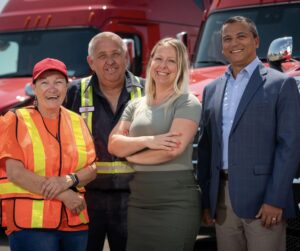
I had the privilege of moderating the discussion that took place at CITT’s conference in Calgary in June, with three respected industry leaders: Mike Millian, President of the Private Motor Truck Council of Canada; Robert Harper, President of the Alberta Motor Transport Association; and Katerina Balog, Director of Business Development at GLS Canada.

We covered tariffs, workforce challenges, AI, sustainability, competitiveness, and the future of the industry. But what stayed with me after the session wasn’t any single topic. It was how often the conversation returned to the same underlying themes: people, leadership, accountability, and collaboration.
Adapting to a new reality
The discussion began with the uncertainty facing our industry today.
Whether it’s tariffs, changing trade relationships, economic pressures, regulatory complexity, or shifting customer expectations, transportation leaders are making decisions in an increasingly challenging environment.
What emerged from the discussion was a recognition that organizations cannot afford to stand still. Success depends on the ability to adapt, respond to change, and continue delivering value despite forces that are often outside our control.
For carriers, shippers, and service providers alike, agility has become an essential business capability.
The workforce conversation has moved beyond shortages
For years, our industry has talked about labour shortages. That conversation still matters, but it is no longer enough.
The panelists spoke about something broader: how to create workplaces where people want to stay, grow, and contribute.
Culture, leadership, transparency, inclusion, and employee development came up repeatedly. The message was clear. The organizations that thrive won’t be the ones that simply hire people. They’ll be the ones that invest in them.
That matters because workforce expectations have changed. Employees are looking for more than a job. They are looking for strong leadership, opportunity, respect, and a workplace culture that supports success.
For an industry that depends so heavily on people, that is not a side issue. It is central to long-term competitiveness.
Technology doesn’t replace accountability
Not surprisingly, artificial intelligence and emerging technologies were part of the discussion.
There is no question that technology has tremendous potential to improve safety, efficiency, visibility, and decision-making across our industry.
But the panel also reinforced a crucial point: technology does not replace accountability.
One audience member captured this well in a LinkedIn post after the session, noting that even when companies use AI to monitor driving behaviour, they cannot rely solely on technology to manage risk and mitigate liability.
That is exactly the right message. Technology can provide insights. It can identify trends. It can support better decisions. But leadership, oversight, and accountability still belong to people.
As organizations continue to invest in AI and other tools, the question will not simply be whether they have the technology. It will be whether they are using it responsibly, thoughtfully, and as part of strong operational practices.
Sustainability requires shared responsibility
Sustainability continues to be a growing priority across the supply chain. At the same time, carriers are facing actual cost pressures, competitive pressures, and operational realities.
The discussion made clear that progress on sustainability cannot rest solely on carriers.
It requires collaboration across the supply chain.
Shippers, customers, carriers, and industry partners all have a role to play in supporting a transportation system that is safe, efficient, competitive, and sustainable.
One point that resonated with many attendees was around pricing. When a carrier offers rates that are significantly lower than others, shippers should be asking why.
The users of trucking services should ask themselves: what investments may not be reflected in that rate?
Compliance, training, workforce development, technology, and sustainability initiatives all come with costs. A healthy transportation sector depends on recognizing the value behind those investments.
Leadership will define the next decade
To close the session, I asked each panelist what they hoped our industry would be talking about ten years from now instead of returning to the same challenges we continue to discuss today.
Their answers reflected different perspectives, but they pointed in a similar direction: a more professionalized, innovative, adaptable, and people-focused industry.
As I listened to three leaders from different parts of the industry, I was struck by how often they arrived at the same conclusion.
- Technology matters.
- Sustainability matters.
- Economic conditions matter.
But long-term success still comes down to people, accountability, leadership, and strong partnerships.
Those are not new ideas. Yet they may be more important today than ever. The challenges facing our industry will continue to evolve. The fundamentals of strong leadership will not.
Stay in the loop!
Sign up for our newsletter and get the latest data, updates, stories, and event announcements delivered to your inbox every week.