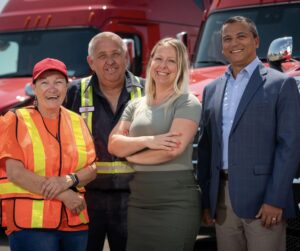




By Angela Splinter, President & CEO, Trucking HR Canada
The recent launch of the Transportation and Supply Chain Workforce Alliance in Calgary by the Hon. Patty Hajdu, Minister of Jobs, marks an important step toward a more connected approach to the workforce challenges affecting how goods move across Canada.
Led by Trucking HR Canada in partnership with CIFFA – Canada’s Association of Logistics Providers, the new Alliance will bring together leaders from road, rail, marine, air cargo, and logistics to strengthen workforce intelligence, identify shared priorities, and advance practical solutions.
The timing matters. Trade patterns are shifting. Technology is changing how work gets done. Demographic pressures are affecting labour supply, while employers across transportation are navigating changing skills requirements and expectations of work. At a time of significant economic uncertainty, Canada needs a clearer picture of the people and skills required across its freight transportation system — and the ability to respond as those needs change.
For Trucking HR Canada, this work builds on nearly two decades of working with employers to understand and address workforce challenges in a sector that operates around the clock.
From trucks, terminals and warehouses to repair shops, distribution centres, and offices, we see every day how workforce needs intersect with safety, compliance, productivity, service, and the daily demands of moving goods. We have also seen the value of combining strong labour-market intelligence with industry expertise to drive practical action.
Taking a system view
Canada’s freight transportation system is deeply interconnected.
Road, rail, marine, and air cargo each play distinct roles, supported by logistics, warehousing, and distribution. Goods rarely move through only one part of that system before reaching their destination.
Trucking is a critical link — connecting ports, rail terminals, airports, and distribution centres with businesses and communities, and providing the first- and last-mile service on which the broader supply chain depends.
The workforce pressures affecting these operations are increasingly connected as well. Labour and skills shortages, demographic change, technology, workforce mobility, and evolving training requirements are reshaping transportation workplaces.
Each mode experiences these pressures differently, but there is considerable value in understanding where they intersect.
Shared challenges require shared solutions
A system-wide view can help identify emerging workforce pressures earlier, uncover opportunities for skills transfer, and highlight areas where greater coordination would benefit employers and workers. It can also reduce duplication and give decision-makers better evidence to act on.
A coordinated approach does not mean a uniform one. Solutions must reflect the operating realities of different modes, regions, and workforces. The opportunity lies in identifying common ground while respecting those differences.
Connecting expertise with action
The strength of the Alliance will come from the experience around the table.
Employers, workers, industry groups, labour representatives, educators, Indigenous organizations, workforce specialists, and governments all bring important perspectives. Together, they can help identify where action is needed and shape solutions grounded in real operating environments.
There is also an opportunity to build on what is already working. Across transportation, organizations have developed effective training approaches, partnerships, data resources, and workforce practices. The Alliance can help connect that work and explore where successful approaches could benefit other parts of the freight system.
For Trucking HR Canada, this is where convening delivers its greatest value: not simply bringing people together, but turning collective expertise into meaningful action.
Preparing for what comes next
Canada’s transportation system will continue to evolve. Technology will reshape jobs and skills. Demographic pressures will affect labour supply. Economic conditions and changing trade patterns will create new pressures — and new opportunities.
In moments of disruption, workforce development cannot be treated as a side conversation. It is part of the response.
The ability to support workers in developing new and transferable skills, strengthen workforce mobility, and connect people with emerging opportunities is essential to both economic resilience and supply chain performance.
That means understanding what is changing, listening to the people closest to the work, and being ready to act on what the evidence tells us.
Trucking HR Canada is proud to lead this work alongside CIFFA and the industry and workforce partners who will help shape it.
By taking a broader view of the workforce behind Canada’s freight system, we can anticipate change, respond to emerging needs, and ensure the people who keep goods moving are ready for what comes next.
Stay in the loop!
Sign up for our newsletter and get the latest data, updates, stories, and event announcements delivered to your inbox every week.