



Federally regulated employers
About this collection
The majority of businesses in the trucking and logistics industry are governed by Canada’s federal laws. These laws are generally set through the Canada Labour Code which includes rules about wages, hours of work, health and safety, vacations, and severance pay. There are also other requirements in legislation such as Pay Equity under the Human Rights Commission, the Accessible Canada Act (ACA), and the Employment Equity Act (LEEP).
THRC has resources to help your company transition and comply as changes to these regulations come into effect.
Canadian regulatory deadlines
Note: Not a comprehensive list of all programs and deadlines; check the government’s Labour Program Forward Regulatory Plan: 2025 to 2027 for more.
| Program | Deadline | Notes |
|---|---|---|
| Legislated Employment Equity Program (LEEP) annual reports | Annually, June 1 | Watch for webinar registration info More: LEEP |
| Accessible Canada Act (ACA) | Progress report annually by June 1 Update Accessibility Plans every 3 years | THRC’s sample Accessibility Plan and other resources More: Canadian Human Rights Commission |
| Pay Equity statements | Annually, June 30 | Watch for webinar registration info More: Pay Equity Act |
| Workplace Harassment and Violence Prevention (WHVP) IMPORTANT: rolling deadlines depend on individual company start date | • Annual Harassment and Violence Occurrence Report, annually by Mar. 1 (as part of Annual Health and Safety reporting) • Refresh training every 3 years • Review and (if necessary) update policies every 3 years • Review workplace risk assessments every 3 years | Watch for webinar registration info More: Workplace Harassment and Violence Prevention |
Updates and resources
Canada Labour Code
Recent changes to the Canada Labour Code that impact trucking and logistics companies.
Canada Labour Code Amendments – In Effect July 9th, 2023
Understand Canada Labour Code amendments that came into effect on July 9, 2023. This resource helps federally regulated trucking and logistics employers review requirements for work-related expense reimbursement, written employment statements, employee rights information, timelines, penalties, onboarding updates, and record retention.
Paid sick days (Canada Labour Code)
Details to help you understand and comply with changes.
Bill C-3 – Canada Labour Code Amendments Explained and a Checklist to Support Compliance
Understand and respond to Bill C-3 Canada Labour Code amendments. This resource helps federally regulated trucking and logistics employers review paid medical leave, extended bereavement leave, existing leave entitlements, policy updates, employee communication, record keeping, and collective agreement considerations.
Managing Paid Medical Leave
Manage paid medical leave with consistency and care. This resource helps trucking and logistics employers understand the benefits of paid medical leave, support employees through illness or injury, strengthen manager practices, prevent misuse, track absences, and address concerns fairly and compassionately.
Medical / Sick Leave Policy Sample
Create a clear medical and sick leave policy for your workplace. This sample helps trucking and logistics employers outline eligibility, paid leave entitlements, qualifying reasons for leave, notification requirements, pay treatment, medical documentation, carry-over rules, record keeping, policy review, and employee acknowledgement.
Workforce harassment and violence (Canada Labour Code)
Tools and guides for your policies and processes.
Complaint Process Infographic
Understand the five key steps in workplace harassment and violence complaint resolution. This infographic helps federally regulated employers review complaints, notify employees, discuss concerns, apply resolution tools, and complete the complaint resolution process.
Understanding workplace harassment and violence prevention regulations – Guide for employees
Understand employee rights and reporting options under Bill C-65. This guide helps federally regulated trucking and logistics employees recognize workplace harassment and violence, understand who is covered, locate the designated recipient, form a complaint, know key timelines, and understand what to expect after reporting.
Understanding workplace harassment and violence prevention regulations – Guide for employers
Understand employer obligations under Bill C-65 and the Workplace Harassment and Violence Prevention Regulations. This guide helps federally regulated trucking and logistics employers review coverage, conduct expectations, timelines, workplace assessments, prevention policies, training, reporting systems, records, annual reporting, and best practices.
Workplace harassment and violence prevention regulations – Guide for designated recipient
Select and support the right Designated Recipient for workplace harassment and violence complaints. This guide helps federally regulated trucking and logistics employers understand the role, responsibilities, required competencies, candidate options, training considerations, and best practices for impartial, confidential, and effective complaint response.
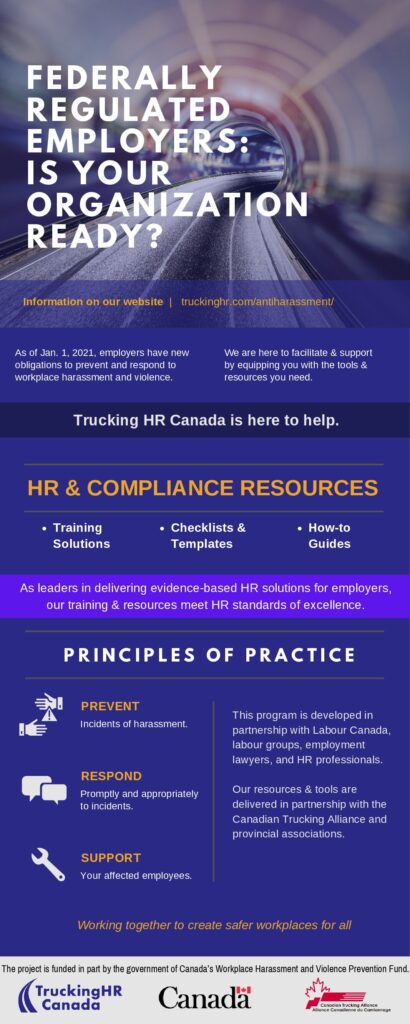
Anti-Harassment Infographic
Explore THRC’s anti-harassment resources for federally regulated trucking and logistics employers. This infographic highlights practical tools to help employers prevent, respond, and support workplace harassment and violence prevention efforts.
Guide to conducting a workplace harassment and violence risk assessment
Assess workplace harassment and violence risks with a practical checklist. This resource helps federally regulated trucking and logistics employers work with their Applicable Partner to identify risks, evaluate controls, recommend preventive measures, communicate risks, and monitor and review workplace risk assessments over time.
Preventing workplace harassment and violence – A toolkit for trucking and logistics employers
Implement workplace harassment and violence prevention policies with confidence. This checklist helps federally regulated trucking and logistics employers review required policy elements, work with the Applicable Partner, conduct risk assessments, communicate the policy, train employees, support ongoing review, and maintain required records.
Workplace Harassment and Violence Prevention Policy Template
Build a clear workplace harassment and violence prevention policy. This template helps federally regulated trucking and logistics employers address Bill C-65 requirements, including prevention commitments, definitions, roles and responsibilities, risk assessment, training, emergency procedures, reporting, resolution, investigations, privacy, support measures, reprisals, and policy review.
Accessible Canada Act
Templates and tools to help you meet your obligations under the Accessible Canada Act.
The Accessible Canada Act – A Sample Progress Report
Document accessibility progress with clarity and confidence. This sample progress report helps federally regulated trucking and logistics employers report on ACA priority areas, consultations with persons with disabilities, feedback received, actions taken, alternate format requirements, and progress toward accessibility plan commitments.
The Accessible Canada Act – A Guide to Developing Your Feedback Process and Sample Template
Develop a clear accessibility feedback process under the Accessible Canada Act. This guide helps federally regulated trucking and logistics employers understand how to receive, acknowledge, retain, consider, publish, and report on accessibility feedback, with a sample template and FAQs to support implementation.
The Accessible Canada Act – A Sample Accessibility Plan
Develop an accessibility plan with confidence. This sample helps federally regulated trucking and logistics employers structure an Accessible Canada Act plan, identify barriers, document actions, consult persons with disabilities, and address accessibility across employment, built environment, communications, procurement, programs, services, and transportation.
LEEP (Employment Equity Act)
Templates and tools to help you meet your obligations under LEEP.
Truck Driver: Pay Categorization Guide
Classify truck driver pay with greater confidence for LEEP reporting. This guide helps federally regulated trucking and logistics employers understand how common driver compensation types, including mileage rates, premiums, incentives, waiting time, bonuses, overtime, and salary, may fit into WEIMS pay reporting categories.
National Occupational Classification: Mapping Guide
Simplify NOC code mapping for employment equity reporting. This guide helps federally regulated trucking and logistics employers identify appropriate National Occupational Classification codes for employee roles across senior management, operations, finance, sales and marketing, HR, planning and engineering, IT, legal, environment, and administration.
Narrative Report: Checklists and Best Practices Guide
Strengthen your Legislated Employment Equity Program Narrative Report. This guide helps federally regulated trucking and logistics employers understand what counts as an equity measure, how to describe results, who should contribute, and how to report actions across equity environment, promotion, accommodation, recruitment, communications, retention, and training.